Article: How Light Transforms Textured Wall Art Throughout the Day
How Light Transforms Textured Wall Art Throughout the Day
The 12-Hour Sunlight Experiment: How Natural Light Redefines Textured Wall Art
You think this piece of art on my wall is completely static, but you're wrong.
By turning off every single studio light and locking down a macro lens for twelve hours, we captured something incredible. Watch how simple sunlight turns heavy plaster ridges into a shifting, dynamic landscape.

The Raw Studio Experiment Setup
To truly observe how natural light interacts with 3D art, we stripped away our controlled environment. We turned off every artificial studio LED, leaving a massive, heavily textured plaster canvas waiting solely for the sun.
We mounted a fixed camera rig with an extreme macro lens focused directly on the deep plaster ridges. By establishing a strict 12-hour static frame rule, we set out to prove a simple thesis: static wall art is actually dynamic when exposed to the continuous sweep of direct sunlight.

Dawn Rays and Raking Light Mechanics
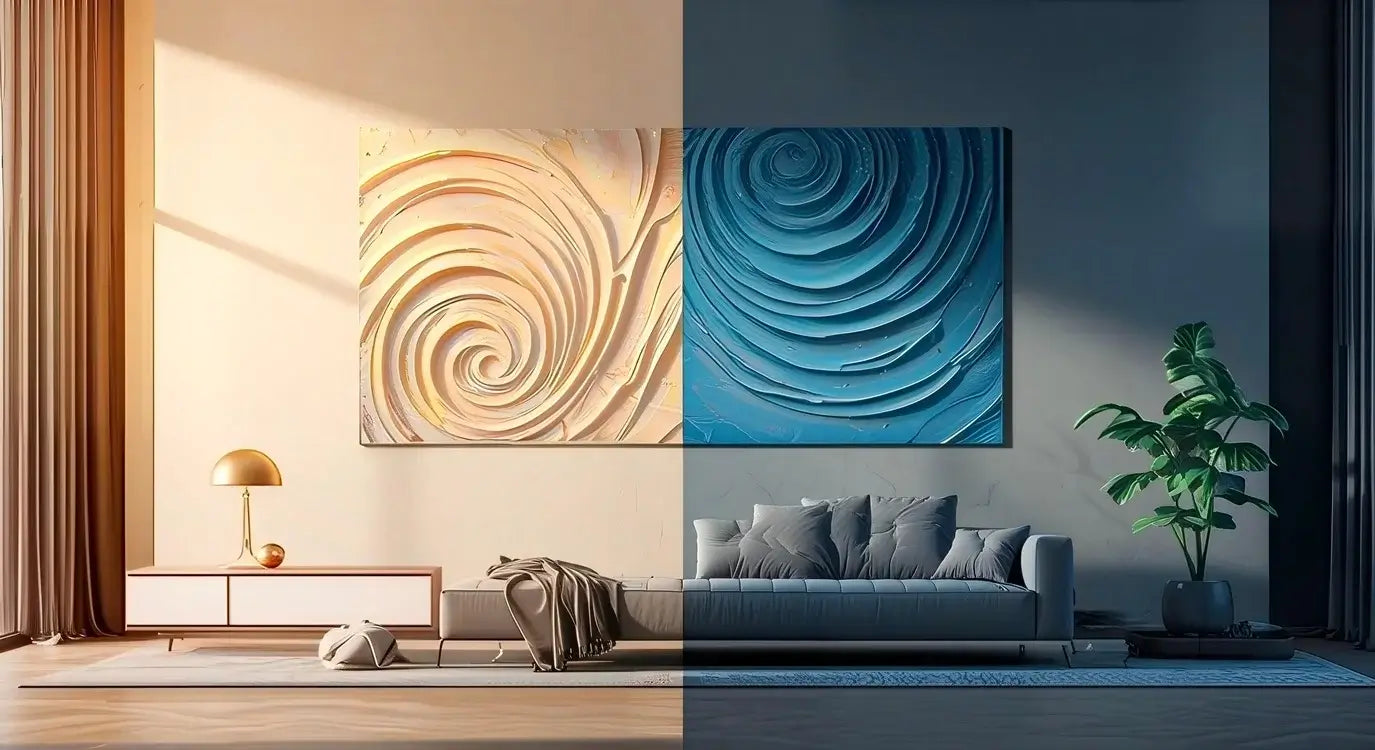
At dawn, the first rays of sunlight hit the canvas at an ultra-low 15-degree angle. This extreme "raking light" instantly creates dramatic visual friction, throwing long, razor-sharp shadows across every single plaster ridge.
Morning raking light acts as a physical magnifying glass—exposing micro-details, hand-carved textures, and subtle imperfections that completely vanish under standard ambient room lighting. As the sun slowly climbs higher, these aggressive morning shadows seamlessly smooth out, gradually softening the artwork's overall visual depth.

Midday Flatness and Texture Loss
By high noon, direct sunlight strikes from an overhead angle, causing the dramatic relief of the plaster to visually collapse.
Under diffuse overhead light, ambient bounce washes out depth, turning dynamic 3D ridges into a flat visual plane. Midday light is the ultimate contrast enemy for heavy plaster art. However, this afternoon visual slump is merely a transition phase before the day's most dramatic transformation.

Golden Hour Volumetrics and Warm Tones
As the late afternoon sun descends, deep shadows return in full force. Warm 2700K golden sunlight cuts across the canvas, wrapping the rough plaster in rich amber and deep obsidian tones.
The contrast between morning's cool raking light and evening's warm directional glow proves that a single piece of wall art acts as two entirely different works throughout the day. As dusk approaches, direct light beams give way to a fading ambient atmosphere.

Dusk Blue Hour & Interior Art Placement Takeaways
During the final blue hour, cool, soft skylight fills the plaster grooves, creating a serene and atmospheric closing view. Playing back the full 12-hour macro time-lapse reveals that textured art is never truly static—it is an evolving canvas driven by the movement of natural light.

How to Position Your Textured Art at Home:
-
Position Near Side Light: Hang heavy plaster or dimensional art on walls perpendicular to windows. Low-angle side light maximizes raking shadows and texture depth.
-
Avoid Direct High-Noon Direct Rays: Avoid hanging textured pieces directly opposite direct overhead windows if you want to avoid flat, washed-out midday visuals.
-
Embrace Ambient Color Shifts: Match your surrounding interior decor to thrive under both cool morning tones and warm golden-hour volumetrics.